Day 15 / 63 · Network foundations
Subnetting (pt 3 VLSM)
Study notes based primarily on Jeremy’s IT Lab CCNA learning videos. Credit to Jeremy’s IT Lab for the source lessons and diagrams.
Subnetting (pt 3 VLSM)
Download original PDF
Text view — Subnetting (pt 3 VLSM)
Extracted from the original export. Diagrams and some formatting appear in the notes above.
Day 15 - Subnetting (pt 3 VLSM)
Saturday, August 22, 2026 2:50 PM
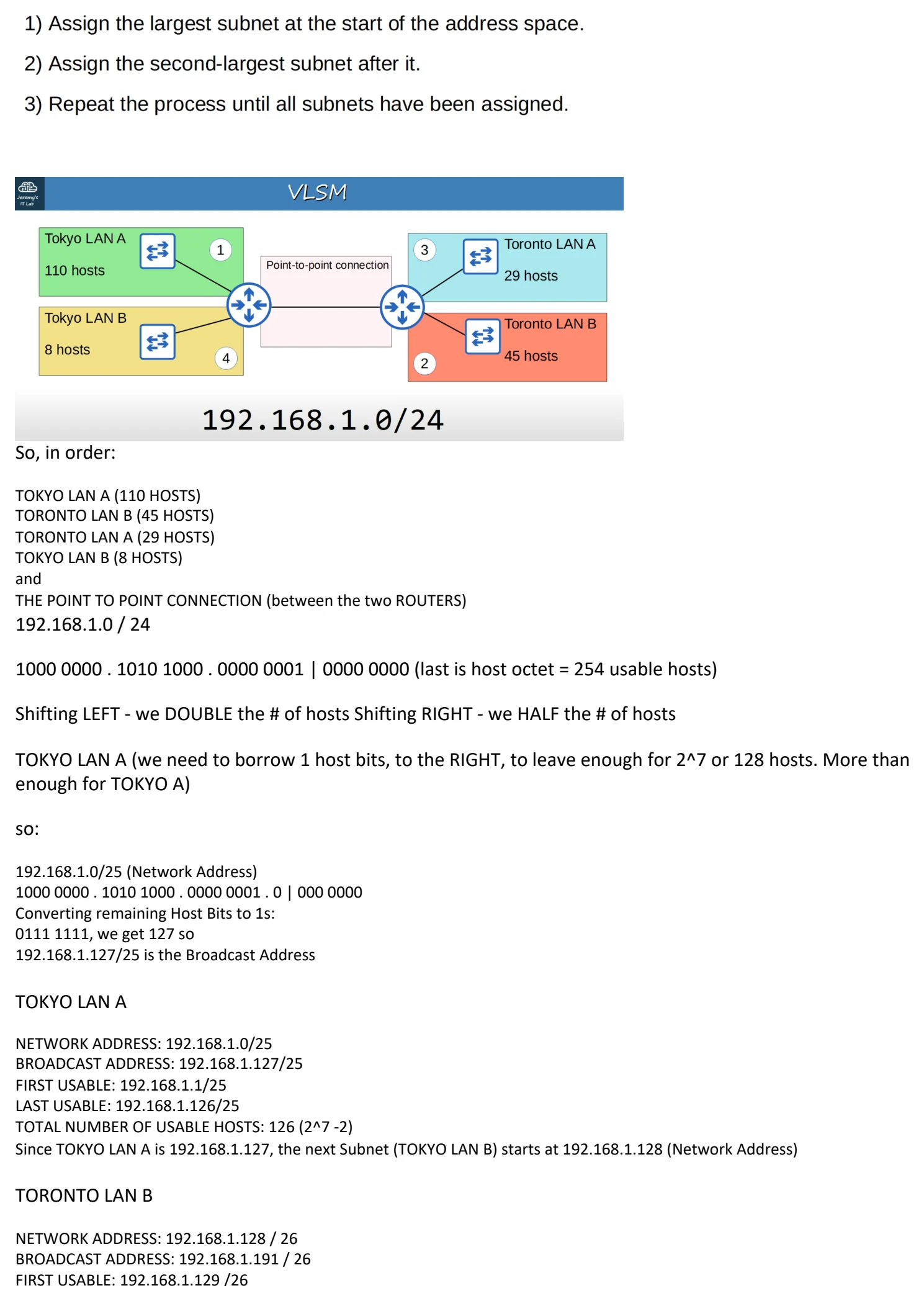
15. SUBNETTING (VLSM) : PART 3
The process of subnetting Class A, Class B, and Class C is identical.
SUBNETTING CLASS A NETWORKS
Given a 10.0.0.0/8 network, you must create 2000 subnets which will distributed to various enterprises. What
prefix length must you use?
2^10 = 1024 so 2^11 = 2048. We have to "borrow" 11 bits (Left to Right) to get enough subnets
0000 1010 . 0000 0000 . 000 | 00000 . 0000 0000
8 bits + 8 bits + 3 = 19 bits
0000 1010 . 0000 0000 . 000 | 00000 . 0000 0000 1111 1111 . 1111 1111 . 111 | 00000 . 0000 0000
255.255.224.0 is the Subnet mask
The answer is /19 (/8 + /11 = /19)
How many hosts per subnet? There are 13 host bits remaining so:
2^13 - 2 = 8190 hosts per subnet
VARIABLE-LENGTH SUBNET MASKS (VLSM)
• Until now, we have practiced subnetting using FLSM (Fixed-Length Subnet Masks).
• This means that all of the subnets use the same prefix length (ie: Subnetting a Class C network into 4
subnets using /26)
• VLSM (Variable-Length Subnet Masks) is the process of creating subnets of different sizes, to make your
use of network addresses more efficient.
• VLSM is more complicated than FLSM, BUT it's easy if you follow the steps correctly.
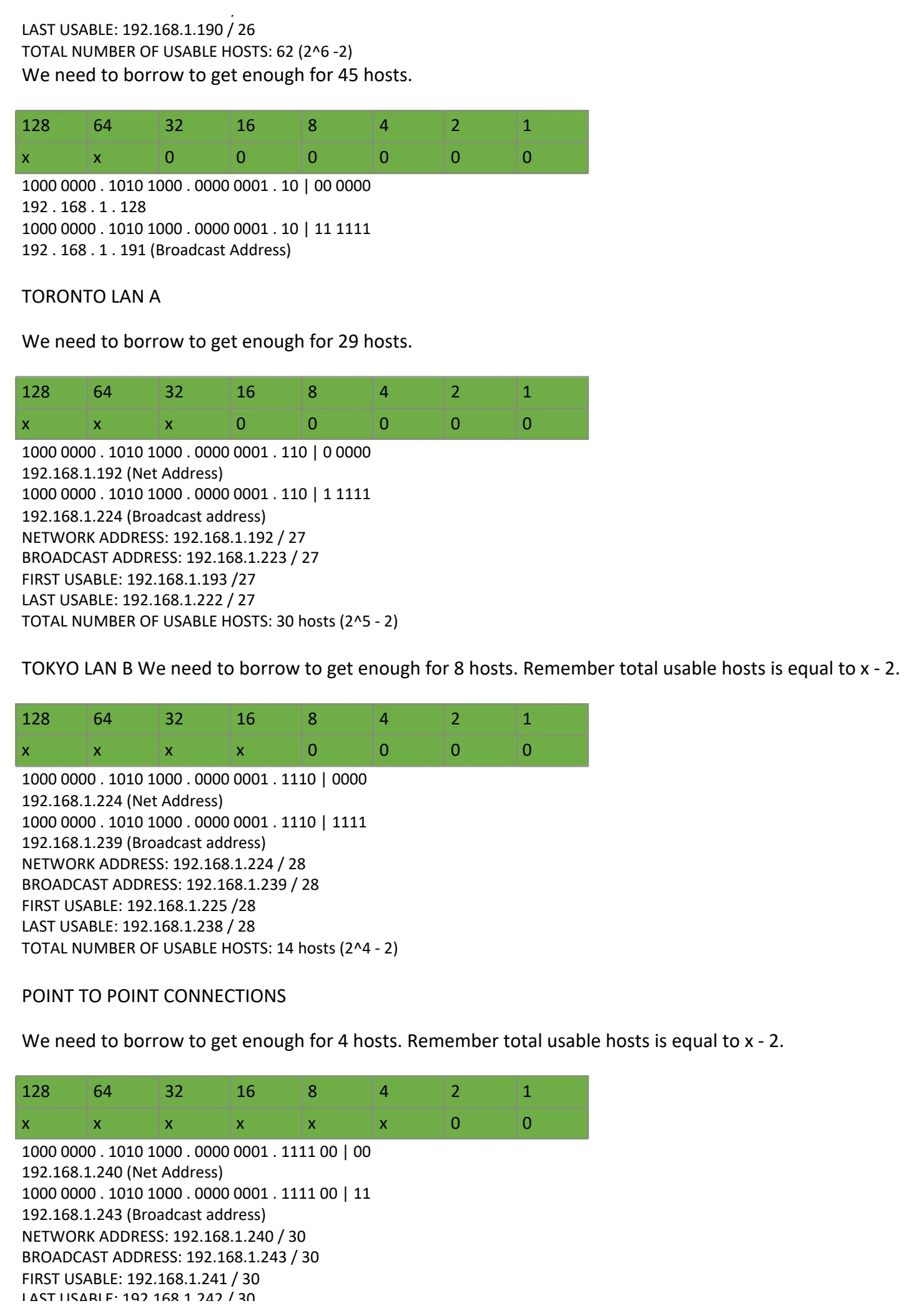
So, in order:
TOKYO LAN A (110 HOSTS)
TORONTO LAN B (45 HOSTS)
TORONTO LAN A (29 HOSTS)
TOKYO LAN B (8 HOSTS)
and
THE POINT TO POINT CONNECTION (between the two ROUTERS)
192.168.1.0 / 24
1000 0000 . 1010 1000 . 0000 0001 | 0000 0000 (last is host octet = 254 usable hosts)
Shifting LEFT - we DOUBLE the # of hosts Shifting RIGHT - we HALF the # of hosts
TOKYO LAN A (we need to borrow 1 host bits, to the RIGHT, to leave enough for 2^7 or 128 hosts. More than
enough for TOKYO A)
so:
192.168.1.0/25 (Network Address)
1000 0000 . 1010 1000 . 0000 0001 . 0 | 000 0000
Converting remaining Host Bits to 1s:
0111 1111, we get 127 so
192.168.1.127/25 is the Broadcast Address
TOKYO LAN A
NETWORK ADDRESS: 192.168.1.0/25
BROADCAST ADDRESS: 192.168.1.127/25
FIRST USABLE: 192.168.1.1/25
LAST USABLE: 192.168.1.126/25
TOTAL NUMBER OF USABLE HOSTS: 126 (2^7 -2)
Since TOKYO LAN A is 192.168.1.127, the next Subnet (TOKYO LAN B) starts at 192.168.1.128 (Network Address)
TORONTO LAN B
NETWORK ADDRESS: 192.168.1.128 / 26
BROADCAST ADDRESS: 192.168.1.191 / 26
FIRST USABLE: 192.168.1.129 /26
LAST USABLE: 192.168.1.190 / 26
TOTAL NUMBER OF USABLE HOSTS: 62 (2^6 -2)
We need to borrow to get enough for 45 hosts.
128 64 32 16 8 4 2 1
x x 0 0 0 0 0 0
1000 0000 . 1010 1000 . 0000 0001 . 10 | 00 0000
192 . 168 . 1 . 128
1000 0000 . 1010 1000 . 0000 0001 . 10 | 11 1111
192 . 168 . 1 . 191 (Broadcast Address)
TORONTO LAN A
We need to borrow to get enough for 29 hosts.
128 64 32 16 8 4 2 1
x x x 0 0 0 0 0
1000 0000 . 1010 1000 . 0000 0001 . 110 | 0 0000
192.168.1.192 (Net Address)
1000 0000 . 1010 1000 . 0000 0001 . 110 | 1 1111
192.168.1.224 (Broadcast address)
NETWORK ADDRESS: 192.168.1.192 / 27
BROADCAST ADDRESS: 192.168.1.223 / 27
FIRST USABLE: 192.168.1.193 /27
LAST USABLE: 192.168.1.222 / 27
TOTAL NUMBER OF USABLE HOSTS: 30 hosts (2^5 - 2)
TOKYO LAN B We need to borrow to get enough for 8 hosts. Remember total usable hosts is equal to x - 2.
128 64 32 16 8 4 2 1
x x x x 0 0 0 0
1000 0000 . 1010 1000 . 0000 0001 . 1110 | 0000
192.168.1.224 (Net Address)
1000 0000 . 1010 1000 . 0000 0001 . 1110 | 1111
192.168.1.239 (Broadcast address)
NETWORK ADDRESS: 192.168.1.224 / 28
BROADCAST ADDRESS: 192.168.1.239 / 28
FIRST USABLE: 192.168.1.225 /28
LAST USABLE: 192.168.1.238 / 28
TOTAL NUMBER OF USABLE HOSTS: 14 hosts (2^4 - 2)
POINT TO POINT CONNECTIONS
We need to borrow to get enough for 4 hosts. Remember total usable hosts is equal to x - 2.
128 64 32 16 8 4 2 1
x x x x x x 0 0
1000 0000 . 1010 1000 . 0000 0001 . 1111 00 | 00
192.168.1.240 (Net Address)
1000 0000 . 1010 1000 . 0000 0001 . 1111 00 | 11
192.168.1.243 (Broadcast address)
NETWORK ADDRESS: 192.168.1.240 / 30
BROADCAST ADDRESS: 192.168.1.243 / 30
FIRST USABLE: 192.168.1.241 / 30
LAST USABLE: 192.168.1.242 / 30
TOTAL NUMBER OF USABLE HOSTS: 2 hosts (2^2 - 2)
ADDITIONAL PRACTICE FOR SUBNETTING
http://www.subnettingquestions.com http://subnetting.org https://subnettingpractice.com *** Preferred site ***

Day 15 - Subnetting (pt 3 VLSM)
Saturday, August 22, 2026 2:50 PM
15. SUBNETTING (VLSM) : PART 3
The process of subnetting Class A, Class B, and Class C is identical.
SUBNETTING CLASS A NETWORKS
Given a 10.0.0.0/8 network, you must create 2000 subnets which will distributed to various enterprises. What
prefix length must you use?
2^10 = 1024 so 2^11 = 2048. We have to "borrow" 11 bits (Left to Right) to get enough subnets
0000 1010 . 0000 0000 . 000 | 00000 . 0000 0000
8 bits + 8 bits + 3 = 19 bits
0000 1010 . 0000 0000 . 000 | 00000 . 0000 0000 1111 1111 . 1111 1111 . 111 | 00000 . 0000 0000
255.255.224.0 is the Subnet mask
The answer is /19 (/8 + /11 = /19)
How many hosts per subnet? There are 13 host bits remaining so:
2^13 - 2 = 8190 hosts per subnet
VARIABLE-LENGTH SUBNET MASKS (VLSM)
• Until now, we have practiced subnetting using FLSM (Fixed-Length Subnet Masks).
• This means that all of the subnets use the same prefix length (ie: Subnetting a Class C network into 4
subnets using /26)
• VLSM (Variable-Length Subnet Masks) is the process of creating subnets of different sizes, to make your
use of network addresses more efficient.
• VLSM is more complicated than FLSM, BUT it's easy if you follow the steps correctly.
So, in order:
TOKYO LAN A (110 HOSTS)
TORONTO LAN B (45 HOSTS)
TORONTO LAN A (29 HOSTS)
TOKYO LAN B (8 HOSTS)
and
THE POINT TO POINT CONNECTION (between the two ROUTERS)
192.168.1.0 / 24
1000 0000 . 1010 1000 . 0000 0001 | 0000 0000 (last is host octet = 254 usable hosts)
Shifting LEFT - we DOUBLE the # of hosts Shifting RIGHT - we HALF the # of hosts
TOKYO LAN A (we need to borrow 1 host bits, to the RIGHT, to leave enough for 2^7 or 128 hosts. More than
enough for TOKYO A)
so:
192.168.1.0/25 (Network Address)
1000 0000 . 1010 1000 . 0000 0001 . 0 | 000 0000
Converting remaining Host Bits to 1s:
0111 1111, we get 127 so
192.168.1.127/25 is the Broadcast Address
TOKYO LAN A
NETWORK ADDRESS: 192.168.1.0/25
BROADCAST ADDRESS: 192.168.1.127/25
FIRST USABLE: 192.168.1.1/25
LAST USABLE: 192.168.1.126/25
TOTAL NUMBER OF USABLE HOSTS: 126 (2^7 -2)
Since TOKYO LAN A is 192.168.1.127, the next Subnet (TOKYO LAN B) starts at 192.168.1.128 (Network Address)
TORONTO LAN B
NETWORK ADDRESS: 192.168.1.128 / 26
BROADCAST ADDRESS: 192.168.1.191 / 26
FIRST USABLE: 192.168.1.129 /26
LAST USABLE: 192.168.1.190 / 26
TOTAL NUMBER OF USABLE HOSTS: 62 (2^6 -2)
We need to borrow to get enough for 45 hosts.
128 64 32 16 8 4 2 1
x x 0 0 0 0 0 0
1000 0000 . 1010 1000 . 0000 0001 . 10 | 00 0000
192 . 168 . 1 . 128
1000 0000 . 1010 1000 . 0000 0001 . 10 | 11 1111
192 . 168 . 1 . 191 (Broadcast Address)
TORONTO LAN A
We need to borrow to get enough for 29 hosts.
128 64 32 16 8 4 2 1
x x x 0 0 0 0 0
1000 0000 . 1010 1000 . 0000 0001 . 110 | 0 0000
192.168.1.192 (Net Address)
1000 0000 . 1010 1000 . 0000 0001 . 110 | 1 1111
192.168.1.224 (Broadcast address)
NETWORK ADDRESS: 192.168.1.192 / 27
BROADCAST ADDRESS: 192.168.1.223 / 27
FIRST USABLE: 192.168.1.193 /27
LAST USABLE: 192.168.1.222 / 27
TOTAL NUMBER OF USABLE HOSTS: 30 hosts (2^5 - 2)
TOKYO LAN B We need to borrow to get enough for 8 hosts. Remember total usable hosts is equal to x - 2.
128 64 32 16 8 4 2 1
x x x x 0 0 0 0
1000 0000 . 1010 1000 . 0000 0001 . 1110 | 0000
192.168.1.224 (Net Address)
1000 0000 . 1010 1000 . 0000 0001 . 1110 | 1111
192.168.1.239 (Broadcast address)
NETWORK ADDRESS: 192.168.1.224 / 28
BROADCAST ADDRESS: 192.168.1.239 / 28
FIRST USABLE: 192.168.1.225 /28
LAST USABLE: 192.168.1.238 / 28
TOTAL NUMBER OF USABLE HOSTS: 14 hosts (2^4 - 2)
POINT TO POINT CONNECTIONS
We need to borrow to get enough for 4 hosts. Remember total usable hosts is equal to x - 2.
128 64 32 16 8 4 2 1
x x x x x x 0 0
1000 0000 . 1010 1000 . 0000 0001 . 1111 00 | 00
192.168.1.240 (Net Address)
1000 0000 . 1010 1000 . 0000 0001 . 1111 00 | 11
192.168.1.243 (Broadcast address)
NETWORK ADDRESS: 192.168.1.240 / 30
BROADCAST ADDRESS: 192.168.1.243 / 30
FIRST USABLE: 192.168.1.241 / 30
LAST USABLE: 192.168.1.242 / 30
TOTAL NUMBER OF USABLE HOSTS: 2 hosts (2^2 - 2)
ADDITIONAL PRACTICE FOR SUBNETTING
http://www.subnettingquestions.com http://subnetting.org https://subnettingpractice.com *** Preferred site ***

Day 15 - Subnetting (pt 3 VLSM)
Saturday, August 22, 2026 2:50 PM
15. SUBNETTING (VLSM) : PART 3
The process of subnetting Class A, Class B, and Class C is identical.
SUBNETTING CLASS A NETWORKS
Given a 10.0.0.0/8 network, you must create 2000 subnets which will distributed to various enterprises. What
prefix length must you use?
2^10 = 1024 so 2^11 = 2048. We have to "borrow" 11 bits (Left to Right) to get enough subnets
0000 1010 . 0000 0000 . 000 | 00000 . 0000 0000
8 bits + 8 bits + 3 = 19 bits
0000 1010 . 0000 0000 . 000 | 00000 . 0000 0000 1111 1111 . 1111 1111 . 111 | 00000 . 0000 0000
255.255.224.0 is the Subnet mask
The answer is /19 (/8 + /11 = /19)
How many hosts per subnet? There are 13 host bits remaining so:
2^13 - 2 = 8190 hosts per subnet
VARIABLE-LENGTH SUBNET MASKS (VLSM)
• Until now, we have practiced subnetting using FLSM (Fixed-Length Subnet Masks).
• This means that all of the subnets use the same prefix length (ie: Subnetting a Class C network into 4
subnets using /26)
• VLSM (Variable-Length Subnet Masks) is the process of creating subnets of different sizes, to make your
use of network addresses more efficient.
• VLSM is more complicated than FLSM, BUT it's easy if you follow the steps correctly.
So, in order:
TOKYO LAN A (110 HOSTS)
TORONTO LAN B (45 HOSTS)
TORONTO LAN A (29 HOSTS)
TOKYO LAN B (8 HOSTS)
and
THE POINT TO POINT CONNECTION (between the two ROUTERS)
192.168.1.0 / 24
1000 0000 . 1010 1000 . 0000 0001 | 0000 0000 (last is host octet = 254 usable hosts)
Shifting LEFT - we DOUBLE the # of hosts Shifting RIGHT - we HALF the # of hosts
TOKYO LAN A (we need to borrow 1 host bits, to the RIGHT, to leave enough for 2^7 or 128 hosts. More than
enough for TOKYO A)
so:
192.168.1.0/25 (Network Address)
1000 0000 . 1010 1000 . 0000 0001 . 0 | 000 0000
Converting remaining Host Bits to 1s:
0111 1111, we get 127 so
192.168.1.127/25 is the Broadcast Address
TOKYO LAN A
NETWORK ADDRESS: 192.168.1.0/25
BROADCAST ADDRESS: 192.168.1.127/25
FIRST USABLE: 192.168.1.1/25
LAST USABLE: 192.168.1.126/25
TOTAL NUMBER OF USABLE HOSTS: 126 (2^7 -2)
Since TOKYO LAN A is 192.168.1.127, the next Subnet (TOKYO LAN B) starts at 192.168.1.128 (Network Address)
TORONTO LAN B
NETWORK ADDRESS: 192.168.1.128 / 26
BROADCAST ADDRESS: 192.168.1.191 / 26
FIRST USABLE: 192.168.1.129 /26
LAST USABLE: 192.168.1.190 / 26
TOTAL NUMBER OF USABLE HOSTS: 62 (2^6 -2)
We need to borrow to get enough for 45 hosts.
128 64 32 16 8 4 2 1
x x 0 0 0 0 0 0
1000 0000 . 1010 1000 . 0000 0001 . 10 | 00 0000
192 . 168 . 1 . 128
1000 0000 . 1010 1000 . 0000 0001 . 10 | 11 1111
192 . 168 . 1 . 191 (Broadcast Address)
TORONTO LAN A
We need to borrow to get enough for 29 hosts.
128 64 32 16 8 4 2 1
x x x 0 0 0 0 0
1000 0000 . 1010 1000 . 0000 0001 . 110 | 0 0000
192.168.1.192 (Net Address)
1000 0000 . 1010 1000 . 0000 0001 . 110 | 1 1111
192.168.1.224 (Broadcast address)
NETWORK ADDRESS: 192.168.1.192 / 27
BROADCAST ADDRESS: 192.168.1.223 / 27
FIRST USABLE: 192.168.1.193 /27
LAST USABLE: 192.168.1.222 / 27
TOTAL NUMBER OF USABLE HOSTS: 30 hosts (2^5 - 2)
TOKYO LAN B We need to borrow to get enough for 8 hosts. Remember total usable hosts is equal to x - 2.
128 64 32 16 8 4 2 1
x x x x 0 0 0 0
1000 0000 . 1010 1000 . 0000 0001 . 1110 | 0000
192.168.1.224 (Net Address)
1000 0000 . 1010 1000 . 0000 0001 . 1110 | 1111
192.168.1.239 (Broadcast address)
NETWORK ADDRESS: 192.168.1.224 / 28
BROADCAST ADDRESS: 192.168.1.239 / 28
FIRST USABLE: 192.168.1.225 /28
LAST USABLE: 192.168.1.238 / 28
TOTAL NUMBER OF USABLE HOSTS: 14 hosts (2^4 - 2)
POINT TO POINT CONNECTIONS
We need to borrow to get enough for 4 hosts. Remember total usable hosts is equal to x - 2.
128 64 32 16 8 4 2 1
x x x x x x 0 0
1000 0000 . 1010 1000 . 0000 0001 . 1111 00 | 00
192.168.1.240 (Net Address)
1000 0000 . 1010 1000 . 0000 0001 . 1111 00 | 11
192.168.1.243 (Broadcast address)
NETWORK ADDRESS: 192.168.1.240 / 30
BROADCAST ADDRESS: 192.168.1.243 / 30
FIRST USABLE: 192.168.1.241 / 30
LAST USABLE: 192.168.1.242 / 30
TOTAL NUMBER OF USABLE HOSTS: 2 hosts (2^2 - 2)
ADDITIONAL PRACTICE FOR SUBNETTING
http://www.subnettingquestions.com http://subnetting.org https://subnettingpractice.com *** Preferred site ***