
Day 06 / 63 · Network foundations
Ethernet LAN Switching (pt 2)
Study notes based primarily on Jeremy’s IT Lab CCNA learning videos. Credit to Jeremy’s IT Lab for the source lessons and diagrams.
Ethernet LAN Switching (pt 2)
Download original PDF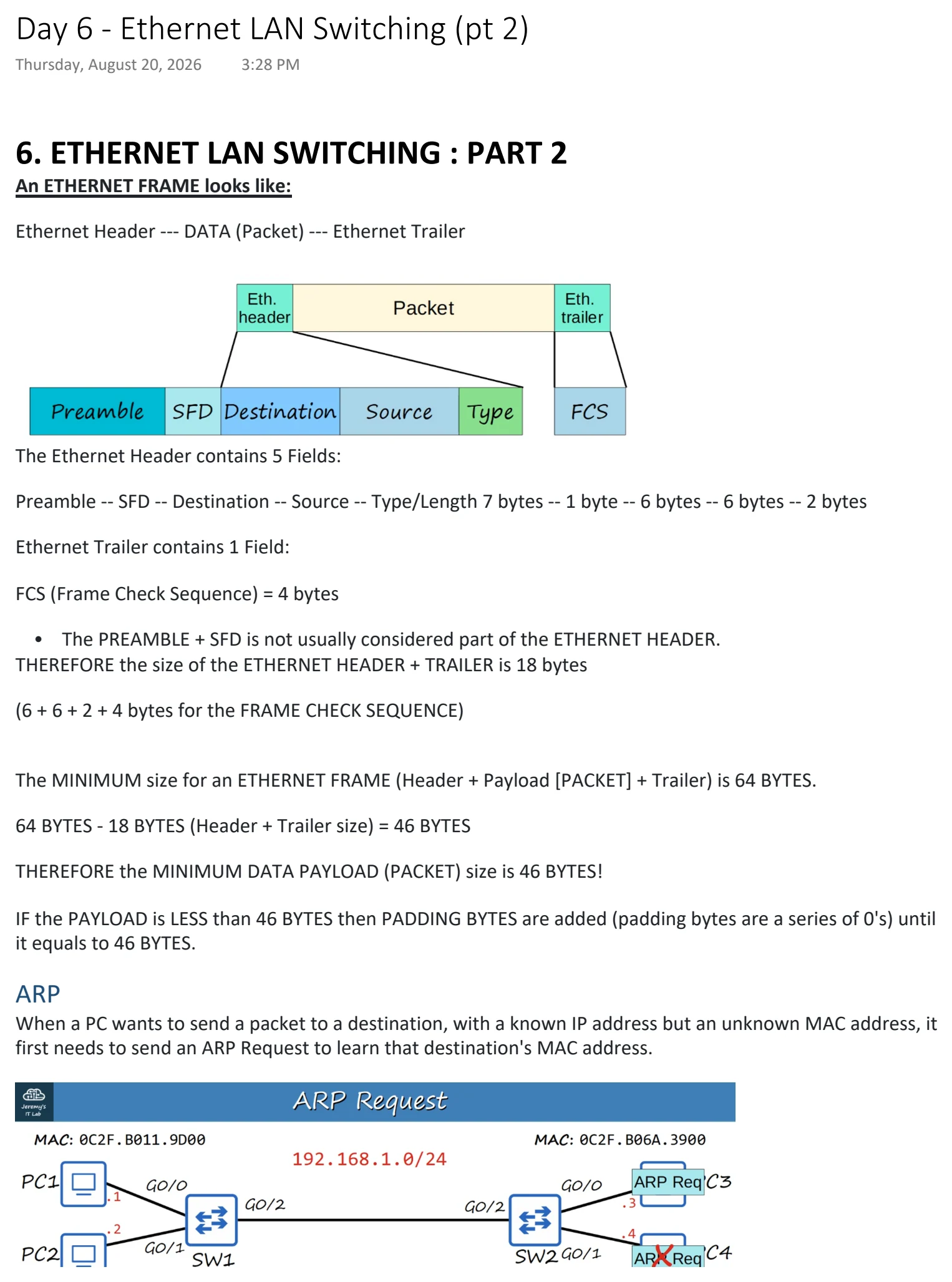
Text view — Ethernet LAN Switching (pt 2)
Extracted from the original export. Diagrams and some formatting appear in the notes above.
Day 6 - Ethernet LAN Switching (pt 2)
Thursday, August 20, 2026 3:28 PM
6. ETHERNET LAN SWITCHING : PART 2
An ETHERNET FRAME looks like:
Ethernet Header --- DATA (Packet) --- Ethernet Trailer
The Ethernet Header contains 5 Fields:
Preamble -- SFD -- Destination -- Source -- Type/Length 7 bytes -- 1 byte -- 6 bytes -- 6 bytes -- 2 bytes
Ethernet Trailer contains 1 Field:
FCS (Frame Check Sequence) = 4 bytes
• The PREAMBLE + SFD is not usually considered part of the ETHERNET HEADER.
THEREFORE the size of the ETHERNET HEADER + TRAILER is 18 bytes
(6 + 6 + 2 + 4 bytes for the FRAME CHECK SEQUENCE)
The MINIMUM size for an ETHERNET FRAME (Header + Payload [PACKET] + Trailer) is 64 BYTES.
64 BYTES - 18 BYTES (Header + Trailer size) = 46 BYTES
THEREFORE the MINIMUM DATA PAYLOAD (PACKET) size is 46 BYTES!
IF the PAYLOAD is LESS than 46 BYTES then PADDING BYTES are added (padding bytes are a series of 0's) until
it equals to 46 BYTES.
ARP
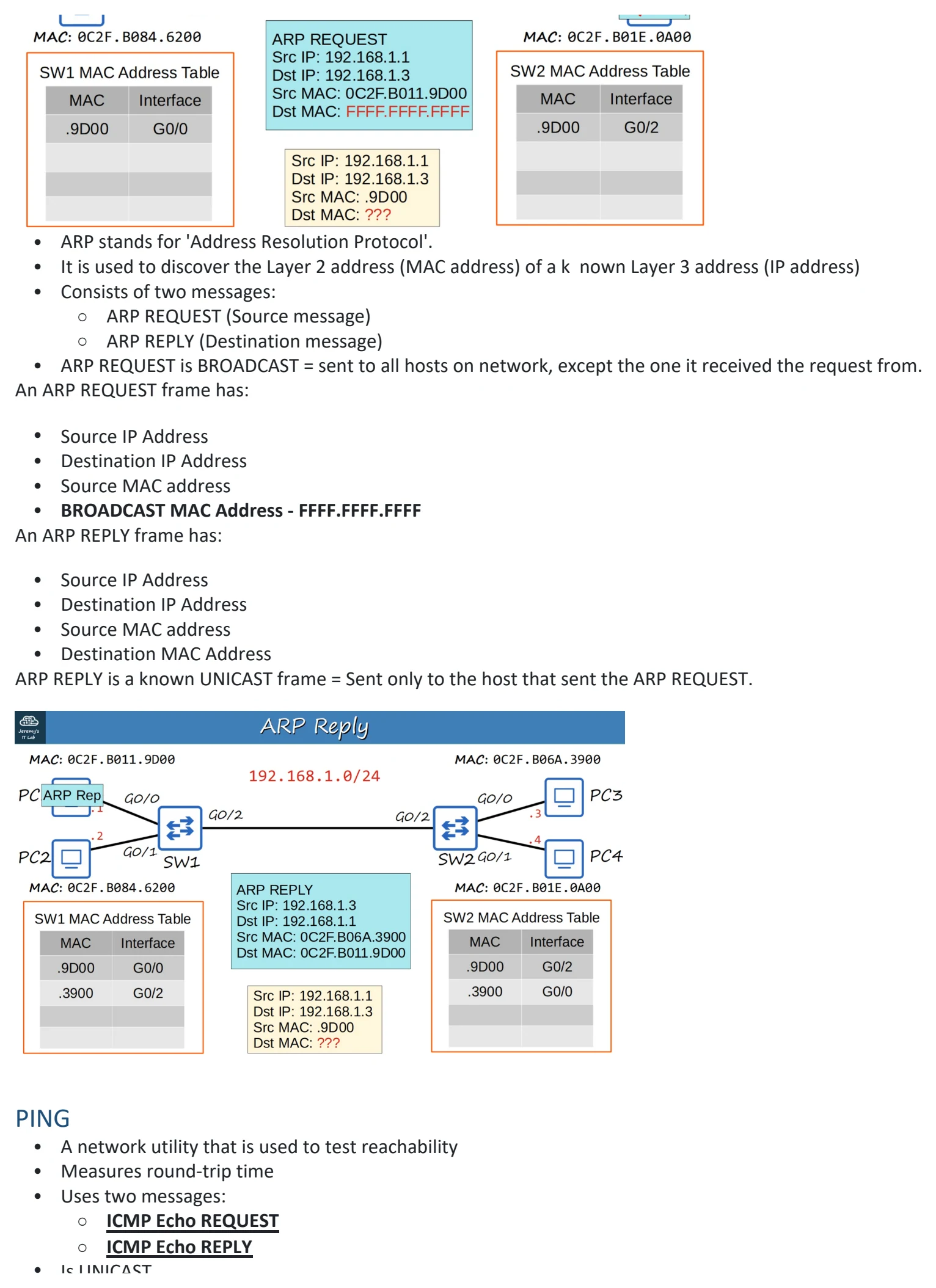
When a PC wants to send a packet to a destination, with a known IP address but an unknown MAC address, it
first needs to send an ARP Request to learn that destination's MAC address.
• ARP stands for 'Address Resolution Protocol'.
• It is used to discover the Layer 2 address (MAC address) of a k nown Layer 3 address (IP address)
• Consists of two messages:
○ ARP REQUEST (Source message)
○ ARP REPLY (Destination message)
• ARP REQUEST is BROADCAST = sent to all hosts on network, except the one it received the request from.
An ARP REQUEST frame has:
• Source IP Address
• Destination IP Address
• Source MAC address
• BROADCAST MAC Address - FFFF.FFFF.FFFF
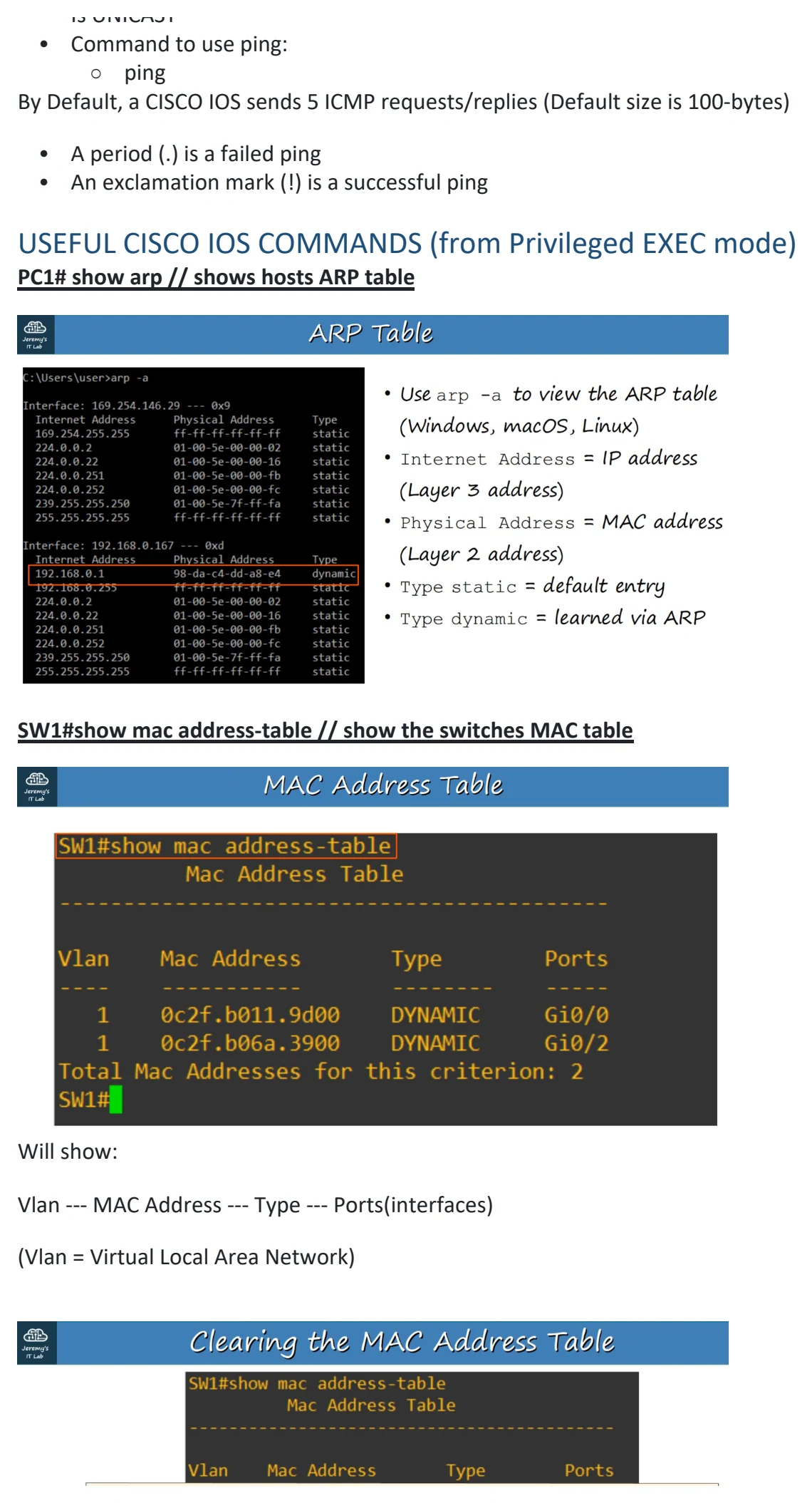
An ARP REPLY frame has:
• Source IP Address
• Destination IP Address
• Source MAC address
• Destination MAC Address
ARP REPLY is a known UNICAST frame = Sent only to the host that sent the ARP REQUEST.
PING
• A network utility that is used to test reachability
• Measures round-trip time
• Uses two messages:
○ ICMP Echo REQUEST
○ ICMP Echo REPLY
• Is UNICAST
• Command to use ping:
○ ping
By Default, a CISCO IOS sends 5 ICMP requests/replies (Default size is 100-bytes)
• A period (.) is a failed ping
• An exclamation mark (!) is a successful ping
USEFUL CISCO IOS COMMANDS (from Privileged EXEC mode)
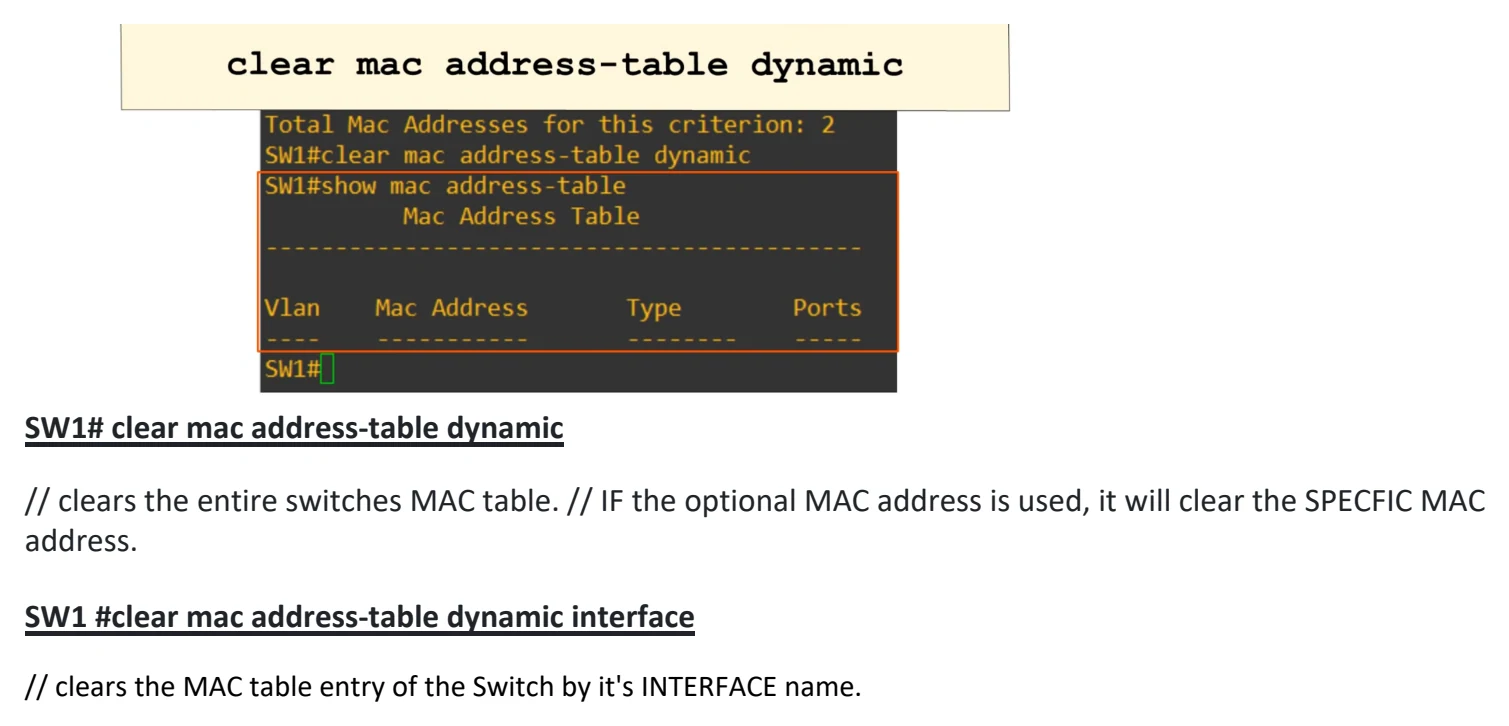
PC1# show arp // shows hosts ARP table
SW1#show mac address-table // show the switches MAC table
Will show:
Vlan --- MAC Address --- Type --- Ports(interfaces)
(Vlan = Virtual Local Area Network)
SW1# clear mac address-table dynamic
// clears the entire switches MAC table. // IF the optional MAC address is used, it will clear the SPECFIC MAC
address.
SW1 #clear mac address-table dynamic interface
// clears the MAC table entry of the Switch by it's INTERFACE name.

Day 6 - Ethernet LAN Switching (pt 2)
Thursday, August 20, 2026 3:28 PM
6. ETHERNET LAN SWITCHING : PART 2
An ETHERNET FRAME looks like:
Ethernet Header --- DATA (Packet) --- Ethernet Trailer
The Ethernet Header contains 5 Fields:
Preamble -- SFD -- Destination -- Source -- Type/Length 7 bytes -- 1 byte -- 6 bytes -- 6 bytes -- 2 bytes
Ethernet Trailer contains 1 Field:
FCS (Frame Check Sequence) = 4 bytes
• The PREAMBLE + SFD is not usually considered part of the ETHERNET HEADER.
THEREFORE the size of the ETHERNET HEADER + TRAILER is 18 bytes
(6 + 6 + 2 + 4 bytes for the FRAME CHECK SEQUENCE)
The MINIMUM size for an ETHERNET FRAME (Header + Payload [PACKET] + Trailer) is 64 BYTES.
64 BYTES - 18 BYTES (Header + Trailer size) = 46 BYTES
THEREFORE the MINIMUM DATA PAYLOAD (PACKET) size is 46 BYTES!
IF the PAYLOAD is LESS than 46 BYTES then PADDING BYTES are added (padding bytes are a series of 0's) until
it equals to 46 BYTES.
ARP
When a PC wants to send a packet to a destination, with a known IP address but an unknown MAC address, it
first needs to send an ARP Request to learn that destination's MAC address.
• ARP stands for 'Address Resolution Protocol'.
• It is used to discover the Layer 2 address (MAC address) of a k nown Layer 3 address (IP address)
• Consists of two messages:
○ ARP REQUEST (Source message)
○ ARP REPLY (Destination message)
• ARP REQUEST is BROADCAST = sent to all hosts on network, except the one it received the request from.
An ARP REQUEST frame has:
• Source IP Address
• Destination IP Address
• Source MAC address
• BROADCAST MAC Address - FFFF.FFFF.FFFF
An ARP REPLY frame has:
• Source IP Address
• Destination IP Address
• Source MAC address
• Destination MAC Address
ARP REPLY is a known UNICAST frame = Sent only to the host that sent the ARP REQUEST.
PING
• A network utility that is used to test reachability
• Measures round-trip time
• Uses two messages:
○ ICMP Echo REQUEST
○ ICMP Echo REPLY
• Is UNICAST
• Command to use ping:
○ ping
By Default, a CISCO IOS sends 5 ICMP requests/replies (Default size is 100-bytes)
• A period (.) is a failed ping
• An exclamation mark (!) is a successful ping
USEFUL CISCO IOS COMMANDS (from Privileged EXEC mode)
PC1# show arp // shows hosts ARP table
SW1#show mac address-table // show the switches MAC table
Will show:
Vlan --- MAC Address --- Type --- Ports(interfaces)
(Vlan = Virtual Local Area Network)
SW1# clear mac address-table dynamic
// clears the entire switches MAC table. // IF the optional MAC address is used, it will clear the SPECFIC MAC
address.
SW1 #clear mac address-table dynamic interface
// clears the MAC table entry of the Switch by it's INTERFACE name.

Day 6 - Ethernet LAN Switching (pt 2)
Thursday, August 20, 2026 3:28 PM
6. ETHERNET LAN SWITCHING : PART 2
An ETHERNET FRAME looks like:
Ethernet Header --- DATA (Packet) --- Ethernet Trailer
The Ethernet Header contains 5 Fields:
Preamble -- SFD -- Destination -- Source -- Type/Length 7 bytes -- 1 byte -- 6 bytes -- 6 bytes -- 2 bytes
Ethernet Trailer contains 1 Field:
FCS (Frame Check Sequence) = 4 bytes
• The PREAMBLE + SFD is not usually considered part of the ETHERNET HEADER.
THEREFORE the size of the ETHERNET HEADER + TRAILER is 18 bytes
(6 + 6 + 2 + 4 bytes for the FRAME CHECK SEQUENCE)
The MINIMUM size for an ETHERNET FRAME (Header + Payload [PACKET] + Trailer) is 64 BYTES.
64 BYTES - 18 BYTES (Header + Trailer size) = 46 BYTES
THEREFORE the MINIMUM DATA PAYLOAD (PACKET) size is 46 BYTES!
IF the PAYLOAD is LESS than 46 BYTES then PADDING BYTES are added (padding bytes are a series of 0's) until
it equals to 46 BYTES.
ARP
When a PC wants to send a packet to a destination, with a known IP address but an unknown MAC address, it
first needs to send an ARP Request to learn that destination's MAC address.
• ARP stands for 'Address Resolution Protocol'.
• It is used to discover the Layer 2 address (MAC address) of a k nown Layer 3 address (IP address)
• Consists of two messages:
○ ARP REQUEST (Source message)
○ ARP REPLY (Destination message)
• ARP REQUEST is BROADCAST = sent to all hosts on network, except the one it received the request from.
An ARP REQUEST frame has:
• Source IP Address
• Destination IP Address
• Source MAC address
• BROADCAST MAC Address - FFFF.FFFF.FFFF
An ARP REPLY frame has:
• Source IP Address
• Destination IP Address
• Source MAC address
• Destination MAC Address
ARP REPLY is a known UNICAST frame = Sent only to the host that sent the ARP REQUEST.
PING
• A network utility that is used to test reachability
• Measures round-trip time
• Uses two messages:
○ ICMP Echo REQUEST
○ ICMP Echo REPLY
• Is UNICAST
• Command to use ping:
○ ping
By Default, a CISCO IOS sends 5 ICMP requests/replies (Default size is 100-bytes)
• A period (.) is a failed ping
• An exclamation mark (!) is a successful ping
USEFUL CISCO IOS COMMANDS (from Privileged EXEC mode)
PC1# show arp // shows hosts ARP table
SW1#show mac address-table // show the switches MAC table
Will show:
Vlan --- MAC Address --- Type --- Ports(interfaces)
(Vlan = Virtual Local Area Network)
SW1# clear mac address-table dynamic
// clears the entire switches MAC table. // IF the optional MAC address is used, it will clear the SPECFIC MAC
address.
SW1 #clear mac address-table dynamic interface
// clears the MAC table entry of the Switch by it's INTERFACE name.

Day 6 - Ethernet LAN Switching (pt 2)
Thursday, August 20, 2026 3:28 PM
6. ETHERNET LAN SWITCHING : PART 2
An ETHERNET FRAME looks like:
Ethernet Header --- DATA (Packet) --- Ethernet Trailer
The Ethernet Header contains 5 Fields:
Preamble -- SFD -- Destination -- Source -- Type/Length 7 bytes -- 1 byte -- 6 bytes -- 6 bytes -- 2 bytes
Ethernet Trailer contains 1 Field:
FCS (Frame Check Sequence) = 4 bytes
• The PREAMBLE + SFD is not usually considered part of the ETHERNET HEADER.
THEREFORE the size of the ETHERNET HEADER + TRAILER is 18 bytes
(6 + 6 + 2 + 4 bytes for the FRAME CHECK SEQUENCE)
The MINIMUM size for an ETHERNET FRAME (Header + Payload [PACKET] + Trailer) is 64 BYTES.
64 BYTES - 18 BYTES (Header + Trailer size) = 46 BYTES
THEREFORE the MINIMUM DATA PAYLOAD (PACKET) size is 46 BYTES!
IF the PAYLOAD is LESS than 46 BYTES then PADDING BYTES are added (padding bytes are a series of 0's) until
it equals to 46 BYTES.
ARP
When a PC wants to send a packet to a destination, with a known IP address but an unknown MAC address, it
first needs to send an ARP Request to learn that destination's MAC address.
• ARP stands for 'Address Resolution Protocol'.
• It is used to discover the Layer 2 address (MAC address) of a k nown Layer 3 address (IP address)
• Consists of two messages:
○ ARP REQUEST (Source message)
○ ARP REPLY (Destination message)
• ARP REQUEST is BROADCAST = sent to all hosts on network, except the one it received the request from.
An ARP REQUEST frame has:
• Source IP Address
• Destination IP Address
• Source MAC address
• BROADCAST MAC Address - FFFF.FFFF.FFFF
An ARP REPLY frame has:
• Source IP Address
• Destination IP Address
• Source MAC address
• Destination MAC Address
ARP REPLY is a known UNICAST frame = Sent only to the host that sent the ARP REQUEST.
PING
• A network utility that is used to test reachability
• Measures round-trip time
• Uses two messages:
○ ICMP Echo REQUEST
○ ICMP Echo REPLY
• Is UNICAST
• Command to use ping:
○ ping
By Default, a CISCO IOS sends 5 ICMP requests/replies (Default size is 100-bytes)
• A period (.) is a failed ping
• An exclamation mark (!) is a successful ping
USEFUL CISCO IOS COMMANDS (from Privileged EXEC mode)
PC1# show arp // shows hosts ARP table
SW1#show mac address-table // show the switches MAC table
Will show:
Vlan --- MAC Address --- Type --- Ports(interfaces)
(Vlan = Virtual Local Area Network)
SW1# clear mac address-table dynamic
// clears the entire switches MAC table. // IF the optional MAC address is used, it will clear the SPECFIC MAC
address.
SW1 #clear mac address-table dynamic interface
// clears the MAC table entry of the Switch by it's INTERFACE name.