
Day 05 / 63 · Network foundations
Ethernet LAN Switching (pt 1)
Study notes based primarily on Jeremy’s IT Lab CCNA learning videos. Credit to Jeremy’s IT Lab for the source lessons and diagrams.
Ethernet LAN Switching (pt 1)
Download original PDF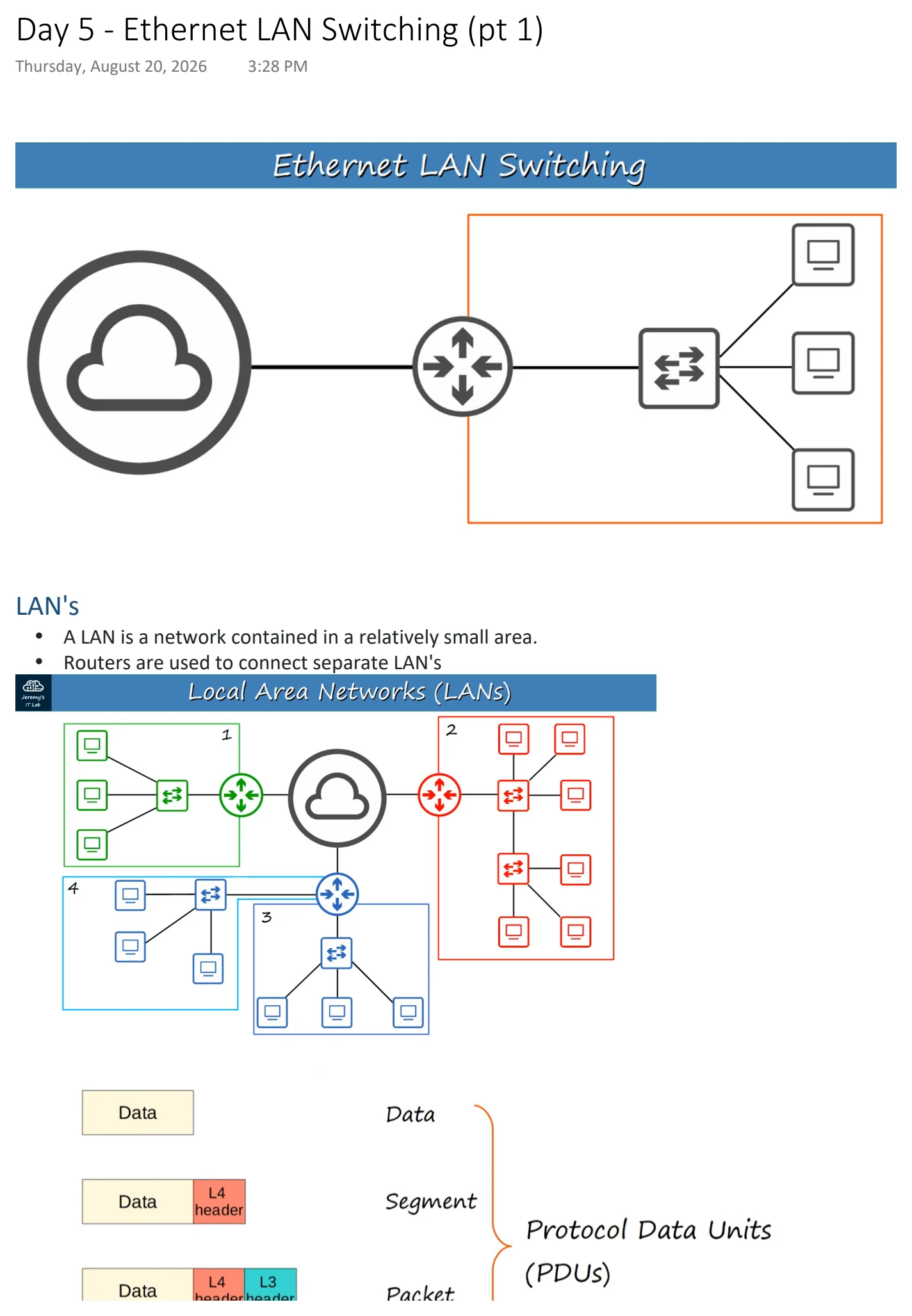
Text view — Ethernet LAN Switching (pt 1)
Extracted from the original export. Diagrams and some formatting appear in the notes above.
Day 5 - Ethernet LAN Switching (pt 1)
Thursday, August 20, 2026 3:28 PM
LAN's
• A LAN is a network contained in a relatively small area.
• Routers are used to connect separate LAN's
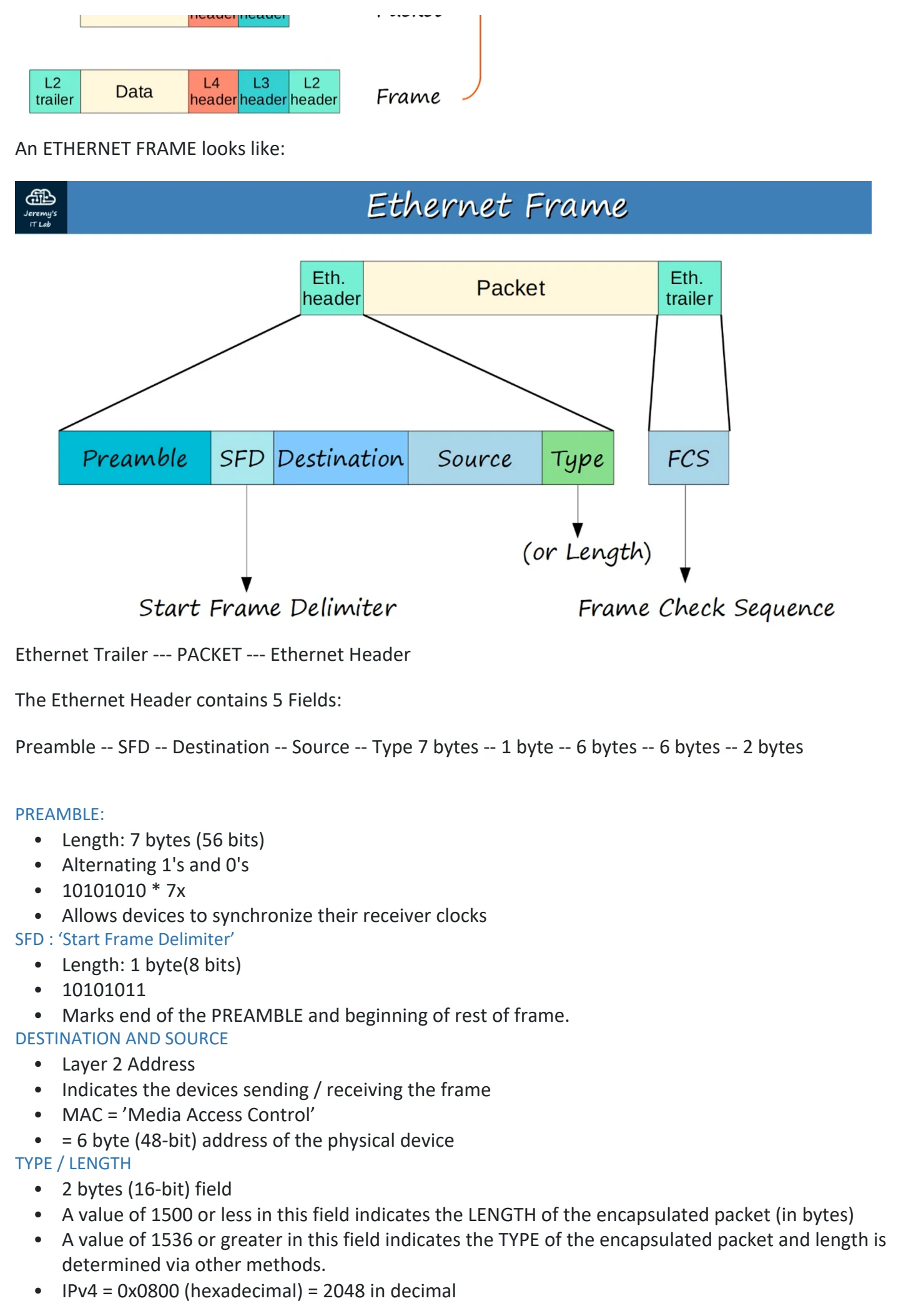
An ETHERNET FRAME looks like:
Ethernet Trailer --- PACKET --- Ethernet Header
The Ethernet Header contains 5 Fields:
Preamble -- SFD -- Destination -- Source -- Type 7 bytes -- 1 byte -- 6 bytes -- 6 bytes -- 2 bytes
PREAMBLE:
• Length: 7 bytes (56 bits)
• Alternating 1's and 0's
• 10101010 * 7x
• Allows devices to synchronize their receiver clocks
SFD : ‘Start Frame Delimiter’
• Length: 1 byte(8 bits)
• 10101011
• Marks end of the PREAMBLE and beginning of rest of frame.
DESTINATION AND SOURCE
• Layer 2 Address
• Indicates the devices sending / receiving the frame
• MAC = ’Media Access Control’
• = 6 byte (48-bit) address of the physical device
TYPE / LENGTH
• 2 bytes (16-bit) field
• A value of 1500 or less in this field indicates the LENGTH of the encapsulated packet (in bytes)
• A value of 1536 or greater in this field indicates the TYPE of the encapsulated packet and length is
determined via other methods.
• IPv4 = 0x0800 (hexadecimal) = 2048 in decimal
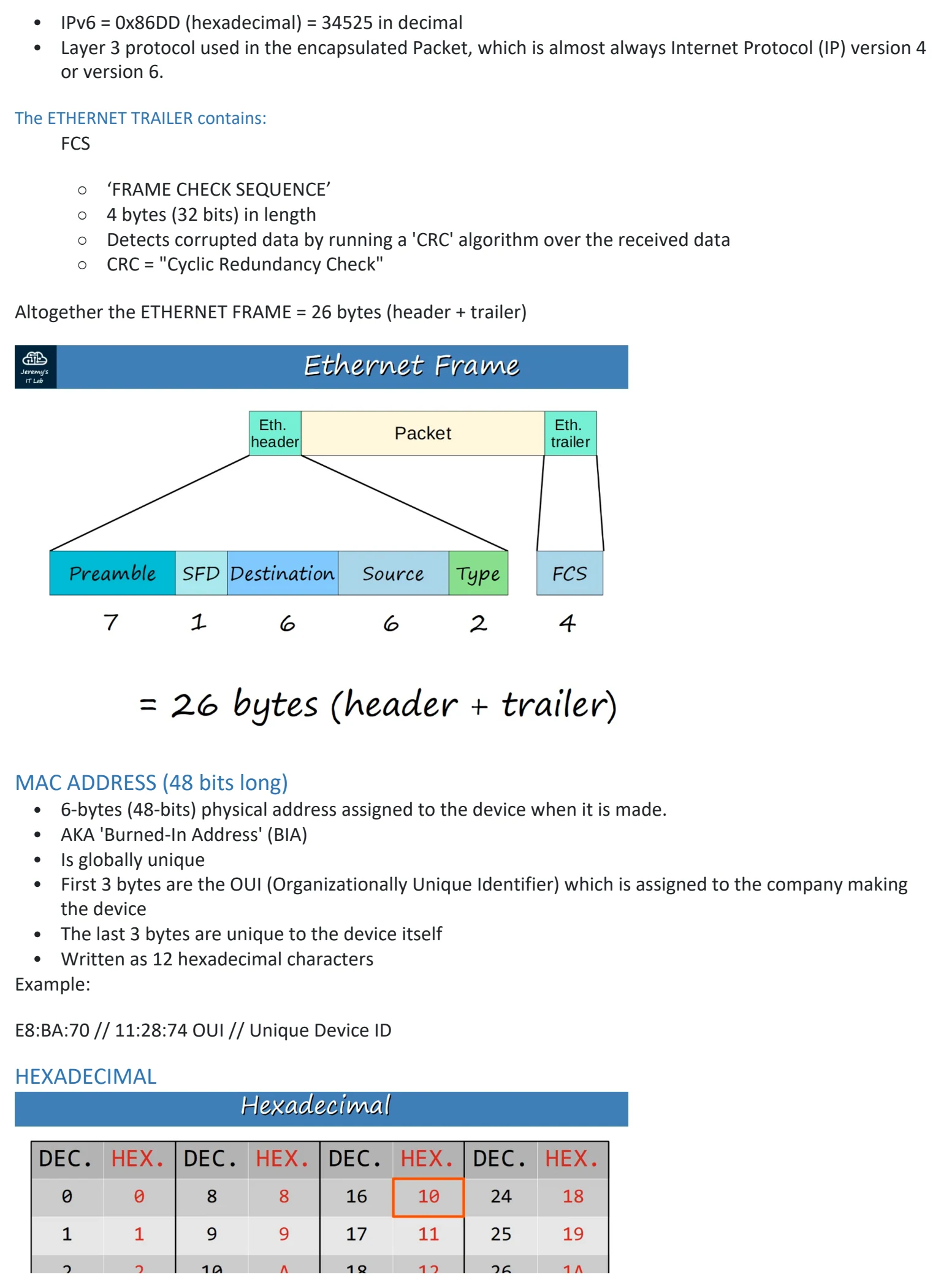
• IPv6 = 0x86DD (hexadecimal) = 34525 in decimal
• Layer 3 protocol used in the encapsulated Packet, which is almost always Internet Protocol (IP) version 4
or version 6.
The ETHERNET TRAILER contains:
FCS
○ ‘FRAME CHECK SEQUENCE’
○ 4 bytes (32 bits) in length
○ Detects corrupted data by running a 'CRC' algorithm over the received data
○ CRC = "Cyclic Redundancy Check"
Altogether the ETHERNET FRAME = 26 bytes (header + trailer)
MAC ADDRESS (48 bits long)
• 6-bytes (48-bits) physical address assigned to the device when it is made.
• AKA 'Burned-In Address' (BIA)
• Is globally unique
• First 3 bytes are the OUI (Organizationally Unique Identifier) which is assigned to the company making
the device
• The last 3 bytes are unique to the device itself
• Written as 12 hexadecimal characters
Example:
E8:BA:70 // 11:28:74 OUI // Unique Device ID
HEXADECIMAL
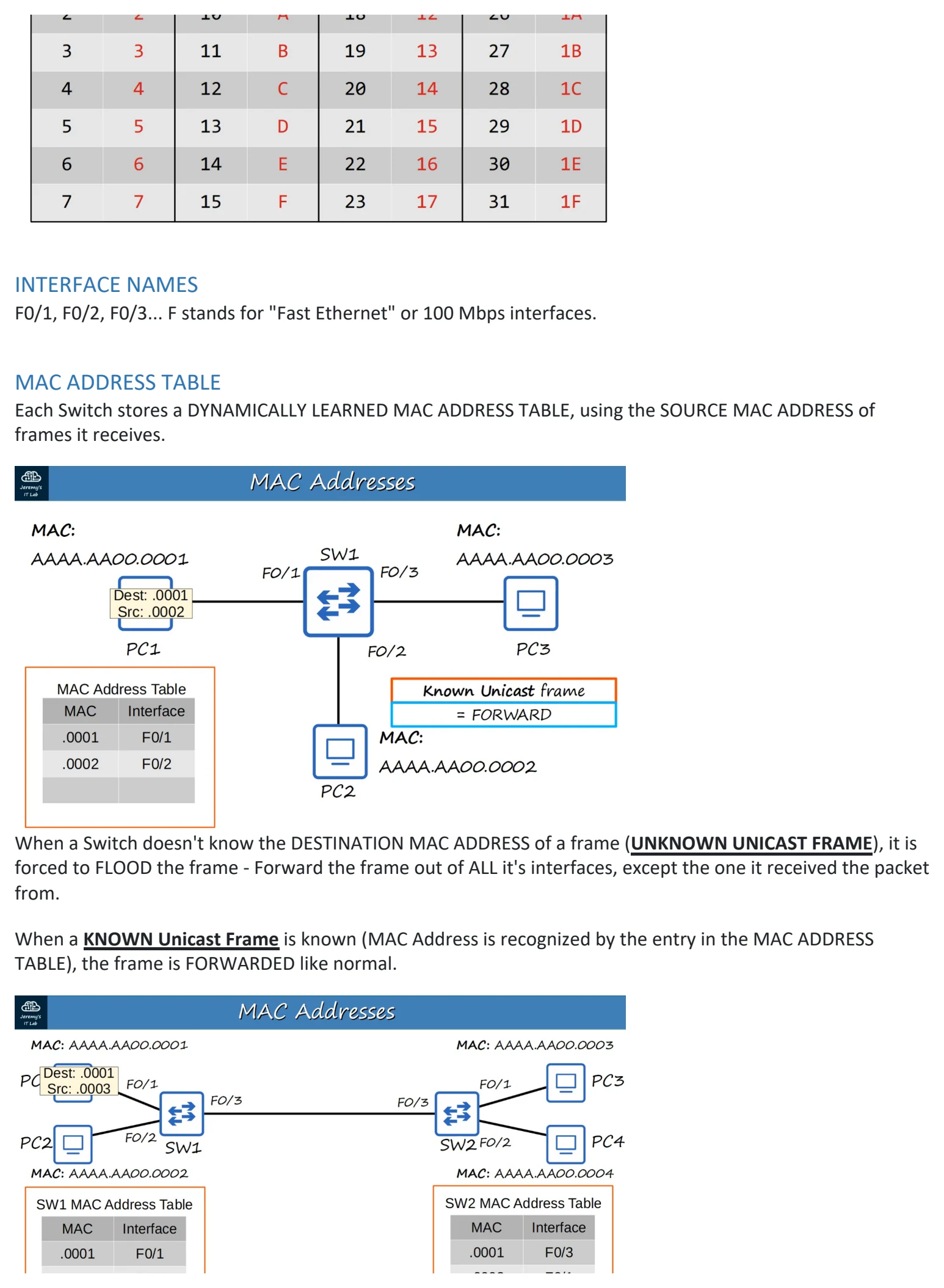
INTERFACE NAMES
F0/1, F0/2, F0/3... F stands for "Fast Ethernet" or 100 Mbps interfaces.
MAC ADDRESS TABLE
Each Switch stores a DYNAMICALLY LEARNED MAC ADDRESS TABLE, using the SOURCE MAC ADDRESS of
frames it receives.
When a Switch doesn't know the DESTINATION MAC ADDRESS of a frame (UNKNOWN UNICAST FRAME), it is
forced to FLOOD the frame - Forward the frame out of ALL it's interfaces, except the one it received the packet
from.
When a KNOWN Unicast Frame is known (MAC Address is recognized by the entry in the MAC ADDRESS
TABLE), the frame is FORWARDED like normal.
• Note: Dynamic MAC Addresses are removed from the MAC ADDRESS TABLE every 5 minutes of inactivity.

Day 5 - Ethernet LAN Switching (pt 1)
Thursday, August 20, 2026 3:28 PM
LAN's
• A LAN is a network contained in a relatively small area.
• Routers are used to connect separate LAN's
An ETHERNET FRAME looks like:
Ethernet Trailer --- PACKET --- Ethernet Header
The Ethernet Header contains 5 Fields:
Preamble -- SFD -- Destination -- Source -- Type 7 bytes -- 1 byte -- 6 bytes -- 6 bytes -- 2 bytes
PREAMBLE:
• Length: 7 bytes (56 bits)
• Alternating 1's and 0's
• 10101010 * 7x
• Allows devices to synchronize their receiver clocks
SFD : ‘Start Frame Delimiter’
• Length: 1 byte(8 bits)
• 10101011
• Marks end of the PREAMBLE and beginning of rest of frame.
DESTINATION AND SOURCE
• Layer 2 Address
• Indicates the devices sending / receiving the frame
• MAC = ’Media Access Control’
• = 6 byte (48-bit) address of the physical device
TYPE / LENGTH
• 2 bytes (16-bit) field
• A value of 1500 or less in this field indicates the LENGTH of the encapsulated packet (in bytes)
• A value of 1536 or greater in this field indicates the TYPE of the encapsulated packet and length is
determined via other methods.
• IPv4 = 0x0800 (hexadecimal) = 2048 in decimal
• IPv6 = 0x86DD (hexadecimal) = 34525 in decimal
• Layer 3 protocol used in the encapsulated Packet, which is almost always Internet Protocol (IP) version 4
or version 6.
The ETHERNET TRAILER contains:
FCS
○ ‘FRAME CHECK SEQUENCE’
○ 4 bytes (32 bits) in length
○ Detects corrupted data by running a 'CRC' algorithm over the received data
○ CRC = "Cyclic Redundancy Check"
Altogether the ETHERNET FRAME = 26 bytes (header + trailer)
MAC ADDRESS (48 bits long)
• 6-bytes (48-bits) physical address assigned to the device when it is made.
• AKA 'Burned-In Address' (BIA)
• Is globally unique
• First 3 bytes are the OUI (Organizationally Unique Identifier) which is assigned to the company making
the device
• The last 3 bytes are unique to the device itself
• Written as 12 hexadecimal characters
Example:
E8:BA:70 // 11:28:74 OUI // Unique Device ID
HEXADECIMAL
INTERFACE NAMES
F0/1, F0/2, F0/3... F stands for "Fast Ethernet" or 100 Mbps interfaces.
MAC ADDRESS TABLE
Each Switch stores a DYNAMICALLY LEARNED MAC ADDRESS TABLE, using the SOURCE MAC ADDRESS of
frames it receives.
When a Switch doesn't know the DESTINATION MAC ADDRESS of a frame (UNKNOWN UNICAST FRAME), it is
forced to FLOOD the frame - Forward the frame out of ALL it's interfaces, except the one it received the packet
from.
When a KNOWN Unicast Frame is known (MAC Address is recognized by the entry in the MAC ADDRESS
TABLE), the frame is FORWARDED like normal.
• Note: Dynamic MAC Addresses are removed from the MAC ADDRESS TABLE every 5 minutes of inactivity.

Day 5 - Ethernet LAN Switching (pt 1)
Thursday, August 20, 2026 3:28 PM
LAN's
• A LAN is a network contained in a relatively small area.
• Routers are used to connect separate LAN's
An ETHERNET FRAME looks like:
Ethernet Trailer --- PACKET --- Ethernet Header
The Ethernet Header contains 5 Fields:
Preamble -- SFD -- Destination -- Source -- Type 7 bytes -- 1 byte -- 6 bytes -- 6 bytes -- 2 bytes
PREAMBLE:
• Length: 7 bytes (56 bits)
• Alternating 1's and 0's
• 10101010 * 7x
• Allows devices to synchronize their receiver clocks
SFD : ‘Start Frame Delimiter’
• Length: 1 byte(8 bits)
• 10101011
• Marks end of the PREAMBLE and beginning of rest of frame.
DESTINATION AND SOURCE
• Layer 2 Address
• Indicates the devices sending / receiving the frame
• MAC = ’Media Access Control’
• = 6 byte (48-bit) address of the physical device
TYPE / LENGTH
• 2 bytes (16-bit) field
• A value of 1500 or less in this field indicates the LENGTH of the encapsulated packet (in bytes)
• A value of 1536 or greater in this field indicates the TYPE of the encapsulated packet and length is
determined via other methods.
• IPv4 = 0x0800 (hexadecimal) = 2048 in decimal
• IPv6 = 0x86DD (hexadecimal) = 34525 in decimal
• Layer 3 protocol used in the encapsulated Packet, which is almost always Internet Protocol (IP) version 4
or version 6.
The ETHERNET TRAILER contains:
FCS
○ ‘FRAME CHECK SEQUENCE’
○ 4 bytes (32 bits) in length
○ Detects corrupted data by running a 'CRC' algorithm over the received data
○ CRC = "Cyclic Redundancy Check"
Altogether the ETHERNET FRAME = 26 bytes (header + trailer)
MAC ADDRESS (48 bits long)
• 6-bytes (48-bits) physical address assigned to the device when it is made.
• AKA 'Burned-In Address' (BIA)
• Is globally unique
• First 3 bytes are the OUI (Organizationally Unique Identifier) which is assigned to the company making
the device
• The last 3 bytes are unique to the device itself
• Written as 12 hexadecimal characters
Example:
E8:BA:70 // 11:28:74 OUI // Unique Device ID
HEXADECIMAL
INTERFACE NAMES
F0/1, F0/2, F0/3... F stands for "Fast Ethernet" or 100 Mbps interfaces.
MAC ADDRESS TABLE
Each Switch stores a DYNAMICALLY LEARNED MAC ADDRESS TABLE, using the SOURCE MAC ADDRESS of
frames it receives.
When a Switch doesn't know the DESTINATION MAC ADDRESS of a frame (UNKNOWN UNICAST FRAME), it is
forced to FLOOD the frame - Forward the frame out of ALL it's interfaces, except the one it received the packet
from.
When a KNOWN Unicast Frame is known (MAC Address is recognized by the entry in the MAC ADDRESS
TABLE), the frame is FORWARDED like normal.
• Note: Dynamic MAC Addresses are removed from the MAC ADDRESS TABLE every 5 minutes of inactivity.

Day 5 - Ethernet LAN Switching (pt 1)
Thursday, August 20, 2026 3:28 PM
LAN's
• A LAN is a network contained in a relatively small area.
• Routers are used to connect separate LAN's
An ETHERNET FRAME looks like:
Ethernet Trailer --- PACKET --- Ethernet Header
The Ethernet Header contains 5 Fields:
Preamble -- SFD -- Destination -- Source -- Type 7 bytes -- 1 byte -- 6 bytes -- 6 bytes -- 2 bytes
PREAMBLE:
• Length: 7 bytes (56 bits)
• Alternating 1's and 0's
• 10101010 * 7x
• Allows devices to synchronize their receiver clocks
SFD : ‘Start Frame Delimiter’
• Length: 1 byte(8 bits)
• 10101011
• Marks end of the PREAMBLE and beginning of rest of frame.
DESTINATION AND SOURCE
• Layer 2 Address
• Indicates the devices sending / receiving the frame
• MAC = ’Media Access Control’
• = 6 byte (48-bit) address of the physical device
TYPE / LENGTH
• 2 bytes (16-bit) field
• A value of 1500 or less in this field indicates the LENGTH of the encapsulated packet (in bytes)
• A value of 1536 or greater in this field indicates the TYPE of the encapsulated packet and length is
determined via other methods.
• IPv4 = 0x0800 (hexadecimal) = 2048 in decimal
• IPv6 = 0x86DD (hexadecimal) = 34525 in decimal
• Layer 3 protocol used in the encapsulated Packet, which is almost always Internet Protocol (IP) version 4
or version 6.
The ETHERNET TRAILER contains:
FCS
○ ‘FRAME CHECK SEQUENCE’
○ 4 bytes (32 bits) in length
○ Detects corrupted data by running a 'CRC' algorithm over the received data
○ CRC = "Cyclic Redundancy Check"
Altogether the ETHERNET FRAME = 26 bytes (header + trailer)
MAC ADDRESS (48 bits long)
• 6-bytes (48-bits) physical address assigned to the device when it is made.
• AKA 'Burned-In Address' (BIA)
• Is globally unique
• First 3 bytes are the OUI (Organizationally Unique Identifier) which is assigned to the company making
the device
• The last 3 bytes are unique to the device itself
• Written as 12 hexadecimal characters
Example:
E8:BA:70 // 11:28:74 OUI // Unique Device ID
HEXADECIMAL
INTERFACE NAMES
F0/1, F0/2, F0/3... F stands for "Fast Ethernet" or 100 Mbps interfaces.
MAC ADDRESS TABLE
Each Switch stores a DYNAMICALLY LEARNED MAC ADDRESS TABLE, using the SOURCE MAC ADDRESS of
frames it receives.
When a Switch doesn't know the DESTINATION MAC ADDRESS of a frame (UNKNOWN UNICAST FRAME), it is
forced to FLOOD the frame - Forward the frame out of ALL it's interfaces, except the one it received the packet
from.
When a KNOWN Unicast Frame is known (MAC Address is recognized by the entry in the MAC ADDRESS
TABLE), the frame is FORWARDED like normal.
• Note: Dynamic MAC Addresses are removed from the MAC ADDRESS TABLE every 5 minutes of inactivity.