
Day 10 / 63 · Network foundations
IPv4 Header
Study notes based primarily on Jeremy’s IT Lab CCNA learning videos. Credit to Jeremy’s IT Lab for the source lessons and diagrams.
IPv4 Header
Download original PDF
Text view — IPv4 Header
Extracted from the original export. Diagrams and some formatting appear in the notes above.
Day 10 - IPv4 Header
Saturday, August 22, 2026 2:50 PM
10. THE IPv4 HEADER
INTERNET PROTOCOL version 4 HEADER or IPv4 HEADER
HEADER is used at LAYER 3 to help send data between devices on separate networks, even on other sides of
the world over the Internet.
This is known as ROUTING.
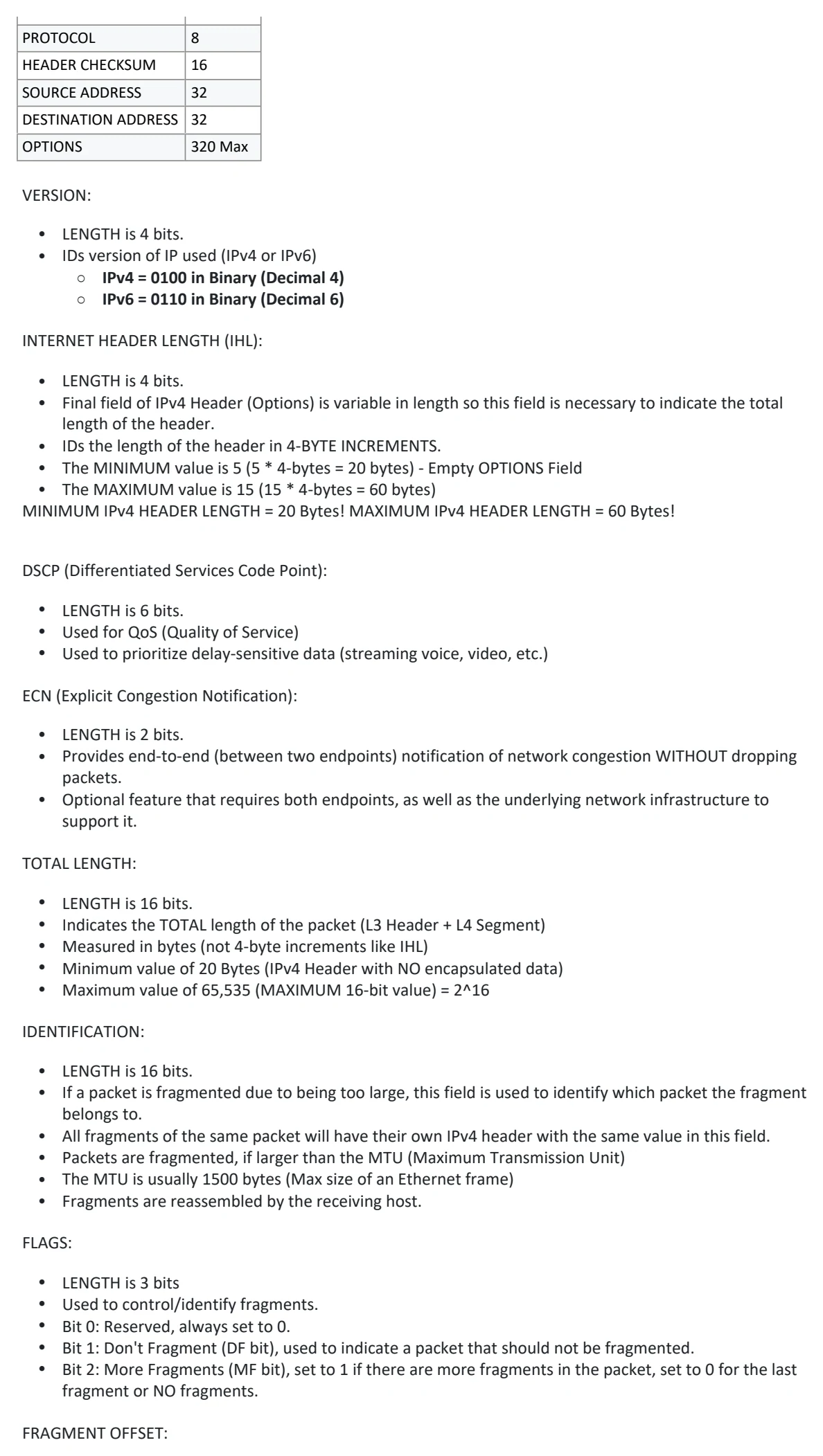
THE IPv4 HEADER is used to ENCAPSULATE a TCP or UDP Segment.
To Review:
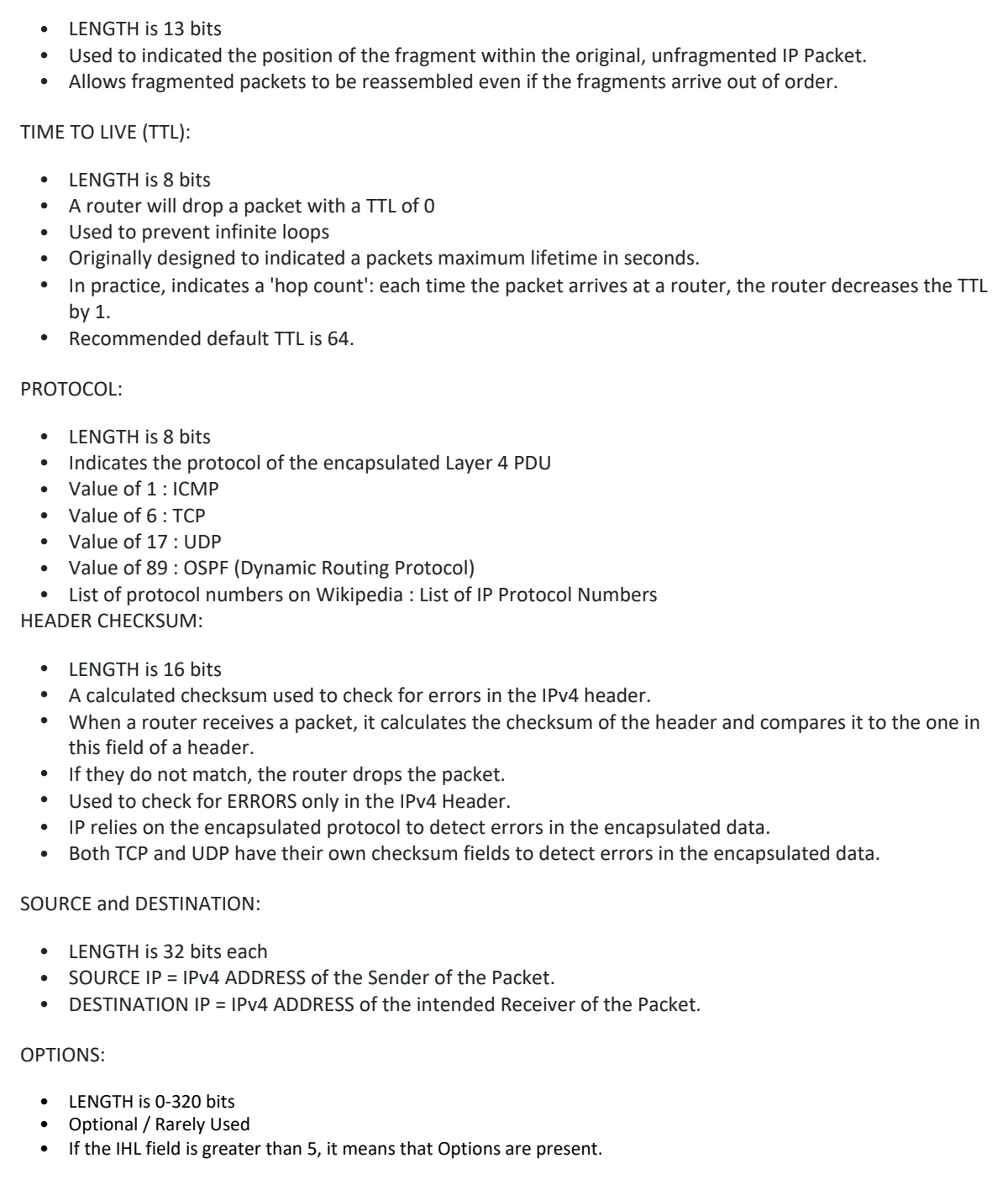
FIELDS OF THE IPv4 HEADER
FIELD # OF BITS
VERSION 4
IHL 4
DSCP 6
ECN 2
TOTAL LENGTH 16
IDENTIFICATION 16
FLAGS 3
FRAGMENT OFFSET 13
TIME TO LIVE 8
PROTOCOL 8
HEADER CHECKSUM 16
SOURCE ADDRESS 32
DESTINATION ADDRESS 32
OPTIONS 320 Max
VERSION:
• LENGTH is 4 bits.
• IDs version of IP used (IPv4 or IPv6)
○ IPv4 = 0100 in Binary (Decimal 4)
○ IPv6 = 0110 in Binary (Decimal 6)
INTERNET HEADER LENGTH (IHL):
• LENGTH is 4 bits.
• Final field of IPv4 Header (Options) is variable in length so this field is necessary to indicate the total
length of the header.
• IDs the length of the header in 4-BYTE INCREMENTS.
• The MINIMUM value is 5 (5 * 4-bytes = 20 bytes) - Empty OPTIONS Field
• The MAXIMUM value is 15 (15 * 4-bytes = 60 bytes)
MINIMUM IPv4 HEADER LENGTH = 20 Bytes! MAXIMUM IPv4 HEADER LENGTH = 60 Bytes!
DSCP (Differentiated Services Code Point):
• LENGTH is 6 bits.
• Used for QoS (Quality of Service)
• Used to prioritize delay-sensitive data (streaming voice, video, etc.)
ECN (Explicit Congestion Notification):
• LENGTH is 2 bits.
• Provides end-to-end (between two endpoints) notification of network congestion WITHOUT dropping
packets.
• Optional feature that requires both endpoints, as well as the underlying network infrastructure to
support it.
TOTAL LENGTH:
• LENGTH is 16 bits.
• Indicates the TOTAL length of the packet (L3 Header + L4 Segment)
• Measured in bytes (not 4-byte increments like IHL)
• Minimum value of 20 Bytes (IPv4 Header with NO encapsulated data)
• Maximum value of 65,535 (MAXIMUM 16-bit value) = 2^16
IDENTIFICATION:
• LENGTH is 16 bits.
• If a packet is fragmented due to being too large, this field is used to identify which packet the fragment
belongs to.
• All fragments of the same packet will have their own IPv4 header with the same value in this field.
• Packets are fragmented, if larger than the MTU (Maximum Transmission Unit)
• The MTU is usually 1500 bytes (Max size of an Ethernet frame)
• Fragments are reassembled by the receiving host.
FLAGS:
• LENGTH is 3 bits
• Used to control/identify fragments.
• Bit 0: Reserved, always set to 0.
• Bit 1: Don't Fragment (DF bit), used to indicate a packet that should not be fragmented.
• Bit 2: More Fragments (MF bit), set to 1 if there are more fragments in the packet, set to 0 for the last
fragment or NO fragments.
FRAGMENT OFFSET:
• LENGTH is 13 bits
• Used to indicated the position of the fragment within the original, unfragmented IP Packet.
• Allows fragmented packets to be reassembled even if the fragments arrive out of order.
TIME TO LIVE (TTL):
• LENGTH is 8 bits
• A router will drop a packet with a TTL of 0
• Used to prevent infinite loops
• Originally designed to indicated a packets maximum lifetime in seconds.
• In practice, indicates a 'hop count': each time the packet arrives at a router, the router decreases the TTL
by 1.
• Recommended default TTL is 64.
PROTOCOL:
• LENGTH is 8 bits
• Indicates the protocol of the encapsulated Layer 4 PDU
• Value of 1 : ICMP
• Value of 6 : TCP
• Value of 17 : UDP
• Value of 89 : OSPF (Dynamic Routing Protocol)
• List of protocol numbers on Wikipedia : List of IP Protocol Numbers
HEADER CHECKSUM:
• LENGTH is 16 bits
• A calculated checksum used to check for errors in the IPv4 header.
• When a router receives a packet, it calculates the checksum of the header and compares it to the one in
this field of a header.
• If they do not match, the router drops the packet.
• Used to check for ERRORS only in the IPv4 Header.
• IP relies on the encapsulated protocol to detect errors in the encapsulated data.
• Both TCP and UDP have their own checksum fields to detect errors in the encapsulated data.
SOURCE and DESTINATION:
• LENGTH is 32 bits each
• SOURCE IP = IPv4 ADDRESS of the Sender of the Packet.
• DESTINATION IP = IPv4 ADDRESS of the intended Receiver of the Packet.
OPTIONS:
• LENGTH is 0-320 bits
• Optional / Rarely Used
• If the IHL field is greater than 5, it means that Options are present.

Day 10 - IPv4 Header
Saturday, August 22, 2026 2:50 PM
10. THE IPv4 HEADER
INTERNET PROTOCOL version 4 HEADER or IPv4 HEADER
HEADER is used at LAYER 3 to help send data between devices on separate networks, even on other sides of
the world over the Internet.
This is known as ROUTING.
THE IPv4 HEADER is used to ENCAPSULATE a TCP or UDP Segment.
To Review:
FIELDS OF THE IPv4 HEADER
FIELD # OF BITS
VERSION 4
IHL 4
DSCP 6
ECN 2
TOTAL LENGTH 16
IDENTIFICATION 16
FLAGS 3
FRAGMENT OFFSET 13
TIME TO LIVE 8
PROTOCOL 8
HEADER CHECKSUM 16
SOURCE ADDRESS 32
DESTINATION ADDRESS 32
OPTIONS 320 Max
VERSION:
• LENGTH is 4 bits.
• IDs version of IP used (IPv4 or IPv6)
○ IPv4 = 0100 in Binary (Decimal 4)
○ IPv6 = 0110 in Binary (Decimal 6)
INTERNET HEADER LENGTH (IHL):
• LENGTH is 4 bits.
• Final field of IPv4 Header (Options) is variable in length so this field is necessary to indicate the total
length of the header.
• IDs the length of the header in 4-BYTE INCREMENTS.
• The MINIMUM value is 5 (5 * 4-bytes = 20 bytes) - Empty OPTIONS Field
• The MAXIMUM value is 15 (15 * 4-bytes = 60 bytes)
MINIMUM IPv4 HEADER LENGTH = 20 Bytes! MAXIMUM IPv4 HEADER LENGTH = 60 Bytes!
DSCP (Differentiated Services Code Point):
• LENGTH is 6 bits.
• Used for QoS (Quality of Service)
• Used to prioritize delay-sensitive data (streaming voice, video, etc.)
ECN (Explicit Congestion Notification):
• LENGTH is 2 bits.
• Provides end-to-end (between two endpoints) notification of network congestion WITHOUT dropping
packets.
• Optional feature that requires both endpoints, as well as the underlying network infrastructure to
support it.
TOTAL LENGTH:
• LENGTH is 16 bits.
• Indicates the TOTAL length of the packet (L3 Header + L4 Segment)
• Measured in bytes (not 4-byte increments like IHL)
• Minimum value of 20 Bytes (IPv4 Header with NO encapsulated data)
• Maximum value of 65,535 (MAXIMUM 16-bit value) = 2^16
IDENTIFICATION:
• LENGTH is 16 bits.
• If a packet is fragmented due to being too large, this field is used to identify which packet the fragment
belongs to.
• All fragments of the same packet will have their own IPv4 header with the same value in this field.
• Packets are fragmented, if larger than the MTU (Maximum Transmission Unit)
• The MTU is usually 1500 bytes (Max size of an Ethernet frame)
• Fragments are reassembled by the receiving host.
FLAGS:
• LENGTH is 3 bits
• Used to control/identify fragments.
• Bit 0: Reserved, always set to 0.
• Bit 1: Don't Fragment (DF bit), used to indicate a packet that should not be fragmented.
• Bit 2: More Fragments (MF bit), set to 1 if there are more fragments in the packet, set to 0 for the last
fragment or NO fragments.
FRAGMENT OFFSET:
• LENGTH is 13 bits
• Used to indicated the position of the fragment within the original, unfragmented IP Packet.
• Allows fragmented packets to be reassembled even if the fragments arrive out of order.
TIME TO LIVE (TTL):
• LENGTH is 8 bits
• A router will drop a packet with a TTL of 0
• Used to prevent infinite loops
• Originally designed to indicated a packets maximum lifetime in seconds.
• In practice, indicates a 'hop count': each time the packet arrives at a router, the router decreases the TTL
by 1.
• Recommended default TTL is 64.
PROTOCOL:
• LENGTH is 8 bits
• Indicates the protocol of the encapsulated Layer 4 PDU
• Value of 1 : ICMP
• Value of 6 : TCP
• Value of 17 : UDP
• Value of 89 : OSPF (Dynamic Routing Protocol)
• List of protocol numbers on Wikipedia : List of IP Protocol Numbers
HEADER CHECKSUM:
• LENGTH is 16 bits
• A calculated checksum used to check for errors in the IPv4 header.
• When a router receives a packet, it calculates the checksum of the header and compares it to the one in
this field of a header.
• If they do not match, the router drops the packet.
• Used to check for ERRORS only in the IPv4 Header.
• IP relies on the encapsulated protocol to detect errors in the encapsulated data.
• Both TCP and UDP have their own checksum fields to detect errors in the encapsulated data.
SOURCE and DESTINATION:
• LENGTH is 32 bits each
• SOURCE IP = IPv4 ADDRESS of the Sender of the Packet.
• DESTINATION IP = IPv4 ADDRESS of the intended Receiver of the Packet.
OPTIONS:
• LENGTH is 0-320 bits
• Optional / Rarely Used
• If the IHL field is greater than 5, it means that Options are present.

Day 10 - IPv4 Header
Saturday, August 22, 2026 2:50 PM
10. THE IPv4 HEADER
INTERNET PROTOCOL version 4 HEADER or IPv4 HEADER
HEADER is used at LAYER 3 to help send data between devices on separate networks, even on other sides of
the world over the Internet.
This is known as ROUTING.
THE IPv4 HEADER is used to ENCAPSULATE a TCP or UDP Segment.
To Review:
FIELDS OF THE IPv4 HEADER
FIELD # OF BITS
VERSION 4
IHL 4
DSCP 6
ECN 2
TOTAL LENGTH 16
IDENTIFICATION 16
FLAGS 3
FRAGMENT OFFSET 13
TIME TO LIVE 8
PROTOCOL 8
HEADER CHECKSUM 16
SOURCE ADDRESS 32
DESTINATION ADDRESS 32
OPTIONS 320 Max
VERSION:
• LENGTH is 4 bits.
• IDs version of IP used (IPv4 or IPv6)
○ IPv4 = 0100 in Binary (Decimal 4)
○ IPv6 = 0110 in Binary (Decimal 6)
INTERNET HEADER LENGTH (IHL):
• LENGTH is 4 bits.
• Final field of IPv4 Header (Options) is variable in length so this field is necessary to indicate the total
length of the header.
• IDs the length of the header in 4-BYTE INCREMENTS.
• The MINIMUM value is 5 (5 * 4-bytes = 20 bytes) - Empty OPTIONS Field
• The MAXIMUM value is 15 (15 * 4-bytes = 60 bytes)
MINIMUM IPv4 HEADER LENGTH = 20 Bytes! MAXIMUM IPv4 HEADER LENGTH = 60 Bytes!
DSCP (Differentiated Services Code Point):
• LENGTH is 6 bits.
• Used for QoS (Quality of Service)
• Used to prioritize delay-sensitive data (streaming voice, video, etc.)
ECN (Explicit Congestion Notification):
• LENGTH is 2 bits.
• Provides end-to-end (between two endpoints) notification of network congestion WITHOUT dropping
packets.
• Optional feature that requires both endpoints, as well as the underlying network infrastructure to
support it.
TOTAL LENGTH:
• LENGTH is 16 bits.
• Indicates the TOTAL length of the packet (L3 Header + L4 Segment)
• Measured in bytes (not 4-byte increments like IHL)
• Minimum value of 20 Bytes (IPv4 Header with NO encapsulated data)
• Maximum value of 65,535 (MAXIMUM 16-bit value) = 2^16
IDENTIFICATION:
• LENGTH is 16 bits.
• If a packet is fragmented due to being too large, this field is used to identify which packet the fragment
belongs to.
• All fragments of the same packet will have their own IPv4 header with the same value in this field.
• Packets are fragmented, if larger than the MTU (Maximum Transmission Unit)
• The MTU is usually 1500 bytes (Max size of an Ethernet frame)
• Fragments are reassembled by the receiving host.
FLAGS:
• LENGTH is 3 bits
• Used to control/identify fragments.
• Bit 0: Reserved, always set to 0.
• Bit 1: Don't Fragment (DF bit), used to indicate a packet that should not be fragmented.
• Bit 2: More Fragments (MF bit), set to 1 if there are more fragments in the packet, set to 0 for the last
fragment or NO fragments.
FRAGMENT OFFSET:
• LENGTH is 13 bits
• Used to indicated the position of the fragment within the original, unfragmented IP Packet.
• Allows fragmented packets to be reassembled even if the fragments arrive out of order.
TIME TO LIVE (TTL):
• LENGTH is 8 bits
• A router will drop a packet with a TTL of 0
• Used to prevent infinite loops
• Originally designed to indicated a packets maximum lifetime in seconds.
• In practice, indicates a 'hop count': each time the packet arrives at a router, the router decreases the TTL
by 1.
• Recommended default TTL is 64.
PROTOCOL:
• LENGTH is 8 bits
• Indicates the protocol of the encapsulated Layer 4 PDU
• Value of 1 : ICMP
• Value of 6 : TCP
• Value of 17 : UDP
• Value of 89 : OSPF (Dynamic Routing Protocol)
• List of protocol numbers on Wikipedia : List of IP Protocol Numbers
HEADER CHECKSUM:
• LENGTH is 16 bits
• A calculated checksum used to check for errors in the IPv4 header.
• When a router receives a packet, it calculates the checksum of the header and compares it to the one in
this field of a header.
• If they do not match, the router drops the packet.
• Used to check for ERRORS only in the IPv4 Header.
• IP relies on the encapsulated protocol to detect errors in the encapsulated data.
• Both TCP and UDP have their own checksum fields to detect errors in the encapsulated data.
SOURCE and DESTINATION:
• LENGTH is 32 bits each
• SOURCE IP = IPv4 ADDRESS of the Sender of the Packet.
• DESTINATION IP = IPv4 ADDRESS of the intended Receiver of the Packet.
OPTIONS:
• LENGTH is 0-320 bits
• Optional / Rarely Used
• If the IHL field is greater than 5, it means that Options are present.